
Clark County Civil Docket Searches
Wisconsin Circuit Court Access is the place to start. Pick Clark County and type in the full case number if you have it. No number handy? Search by a party or business name, then filter by filing date, status, and case class. The letter codes are simple: CV for civil, SC for small claims, FA for family, and PR for probate. Always confirm the class on the result itself.
- Search Clark County by case number or name.
- Match the caption, filing date, class, and party role.
- Read events for service, answers, motions, settings, and judgment.
- Use eFiling only when authorized to view party documents.
- Ask the Clerk for a filed document, certified copy, or older record.
You can reach the Clerk of Courts several ways. Visit the Room 405 counter, mail a request to 517 Court Street, Neillsville, WI 54456, call 715-743-5181 or 715-743-5183, or email heather.bravener@wicourts.gov. State public-record law backs a focused written request, though court-specific limits still apply.
Clark Rule 400 Service Review
Clark local Rule 400 puts a county-specific clock on this civil docket. Proof of service is due within 20 days after service. 140 days after filing, the court reviews the action. It checks for that proof and for an answer. The case may not be at issue by then. In that event, the rule permits dismissal or default under its terms. That review explains docket entries that can look sudden. A service filing shows process was delivered in the stated way. An answer puts the defense response on the record. Default is not just a missed hearing by another name. Dismissal language means exactly what it says.
File all civil papers with the Clark County Clerk of Courts. Local Rule 302 says not to file them directly with a judge or another office.
Civil Dockets: What They Show
Think of a Clark County civil docket as an index with an event history attached. The full case file is where the substance sits: complaints, proof of service, exhibits, briefs, orders, and judgments. How much detail WCCA shows the public varies by record and access status.
| Case number | A format such as 2026-CV-000123, with year, class, and sequence. |
|---|---|
| Caption and parties | The styled case name and roles, not a finding on the merits. |
| Service and answer | Events showing process and a response. |
| Motions and orders | Requests made and rulings entered. |
| Settings | Scheduling conference, pretrial, hearing, trial, or return date. |
| Judgment | The court-entered result and financial data when public. |
A printed screen is never a certified judgment; ask the clerk for the official copy when certification matters.
Clark Telephonic Civil Scheduling
Local Rule 401 has the clerk issue an order for a telephonic scheduling conference after filing. The plaintiff serves that order with the summons and complaint, then starts the call. Local Rule 300 also favors telephone proceedings where allowed and asks for 48 hours' notice when practical. Remember, a scheduling conference manages the case. It is not a trial. Deadlines and later dates may come out of it. Rule 410 separately requires notice of any settlement or agreement at least ten calendar days before trial. That deadline is not an invitation to a hearing. Before counting on any date, check the latest order. Also check the WCCA event history, the clerk, or the branch. A changed setting can leave the earlier event still visible.
What Cases Fill the Civil Docket
The Clark County Circuit Court docket covers general civil actions, family matters, small claims, and probate-related proceedings. Each group carries its own party roles and record limits.
| Class | Common docket trail | Access point |
|---|---|---|
| Civil | Complaint, service, answer, motions, scheduling, judgment | WCCA and Clerk |
| Small claims | Filing, service, return date, answer or default, judgment | WCCA and county small-claims process |
| Family | Petition, service, hearings, orders, judgment | WCCA subject to privacy limits |
| Probate | Petitions, notices, hearings, orders | Clerk or Register in Probate route |
A family case showing in public results does not mean every filed financial or child-related document is public.
Clark Small Claims Return Dates
The Clark County small-claims page explains the process. The clerk sets the return date and puts it right on the paperwork. The plaintiff has to appear. Service steps change depending on whether the defendant is inside Clark County, outside it, or whether the case is an eviction or replevin action. A return date is not automatically a trial date.
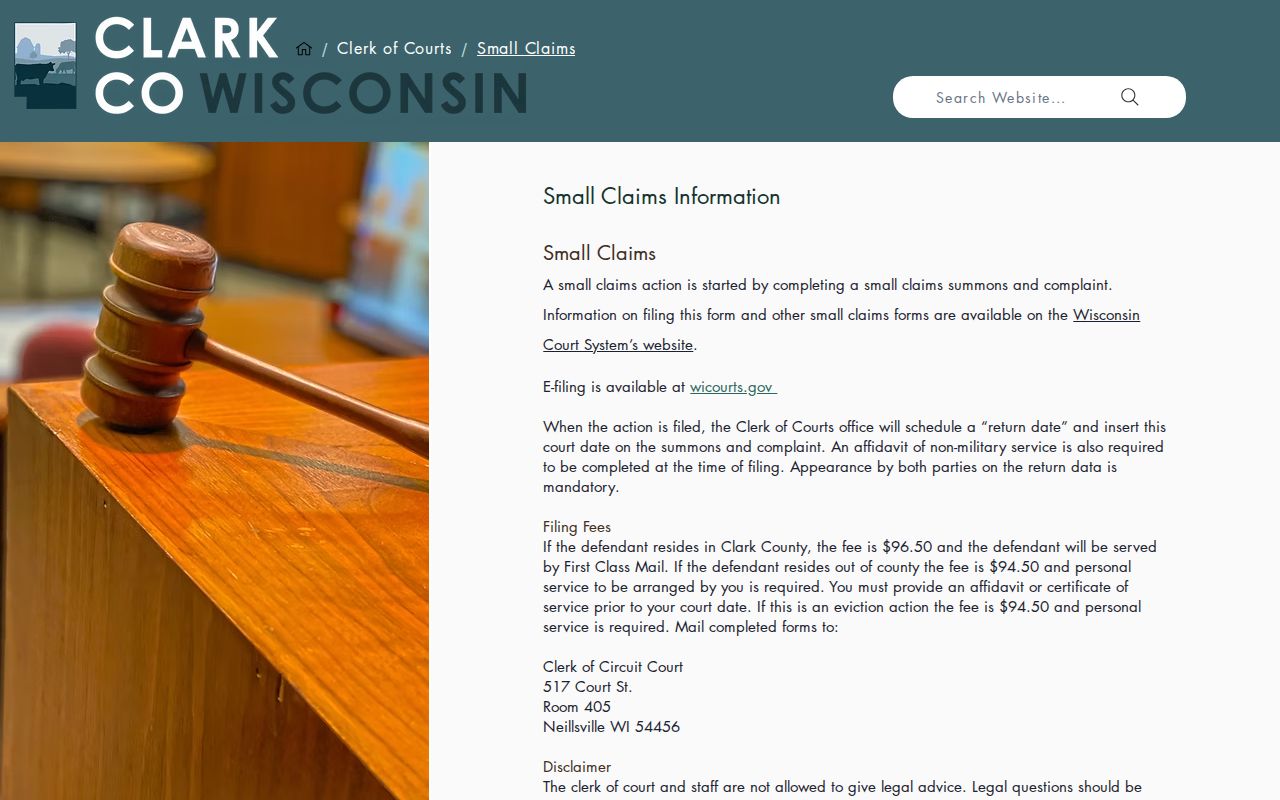
That county page is the local route for filing, service, and return-date facts a generic state summary may skip. One fee wrinkle is worth catching. The county displays a $96.50 in-county amount. The current statewide chart lists $94.50 for small claims. Since the official figures differ, confirm the current total with the clerk before you file or pay.
Hearings on the Civil Docket
A Clark County civil setting can take several forms. It might be a scheduling conference, motion hearing, pretrial, trial, status review, or small-claims return date. The label tells you what kind of event it is. Watch for "continued" or "reset." Those words mean the hearing moved to a new date, nothing more. The civil case itself is still open.
Clark County posts no standalone official daily calendar. Use WCCA whenever a setting appears there, check the served summons or order, or call the clerk or branch line. Authorized eFiling users can also check notices and documents in their account.
If a setting is missing, have the case number ready and ask for the date, time, branch, location or phone instructions, and the type of setting. An old printout is not reliable.
Clark Civil Caseload Context
For scale, the 2024 report counts 85 civil actions opened, along with 38 divorces, 7 paternity actions, 23 other family matters, 3 contested small claims, and 279 uncontested small claims. The combined civil and family row shows 435 opened and 440 disposed.
Read those figures as workload categories, not unique people or a forecast for any one case. Contested and uncontested small claims sit on separate rows for good reason.
Who Can See Civil Dockets
Wisconsin leans toward openness. Statute §19.35 sets a broad baseline that anyone can read court records, though other statutes carve out protected data. Section 801.19 shields key personal identifiers. Sections 801.20 and 801.21 govern which court records stay confidential or get sealed and redacted.
So a Clark County civil docket may show the public summary of a case while an exhibit, a financial statement, a minor's details, or a family filing sits behind restriction. WCCA never holds the whole file. The clerk can tell you the correct request route for those items, though the office cannot give legal advice on what to file.
If a complaint is listed but its exhibit is not viewable, request the specific document from the Clerk and ask whether access is restricted.
Retention follows Supreme Court Rule Chapter 72 as well. An old Clark County civil docket that has vanished from view may simply be stored or disposed of under that schedule rather than posted online.
Clark Civil Files Beyond WCCA
A Clark civil docket entry can name a complaint, proof of service, motion, order, or judgment. The paper itself may not be open on the web. WCCA carries public case information. The Clerk of Court keeps the written record. eFiling gives authorized parties role-based access to documents.
Request the exact item listed. Give the case number and the title or event date. Say whether a plain or certified copy is needed. Local Rule 301 permits a narrow fax route at 715-743-5187 for some no-fee items. Those include a copy request of one page or less. Fax never replaces eFiling, and the sender must confirm the clerk received it.
Older Clark civil records may sit outside the public web view entirely. Supreme Court Rule Chapter 72 sets retention schedules for civil files and judgment dockets. Ask the clerk whether material survives in paper, electronic, or preserved form. Not online does not mean no record exists.
One caution worth repeating: a WCCA judgment line is not the signed judgment. A plain copy just reproduces the record. A certified copy carries the clerk's certification. Ask which service fits, and confirm the current charge. For a mailed request, include the CV or SC number, caption, document date, and a return address.
Later events keep coming after judgment. Satisfaction, payment, enforcement, appeal, or review each adds entries to the docket. Read through the newest Clark event before assuming the first judgment line still reflects current status.